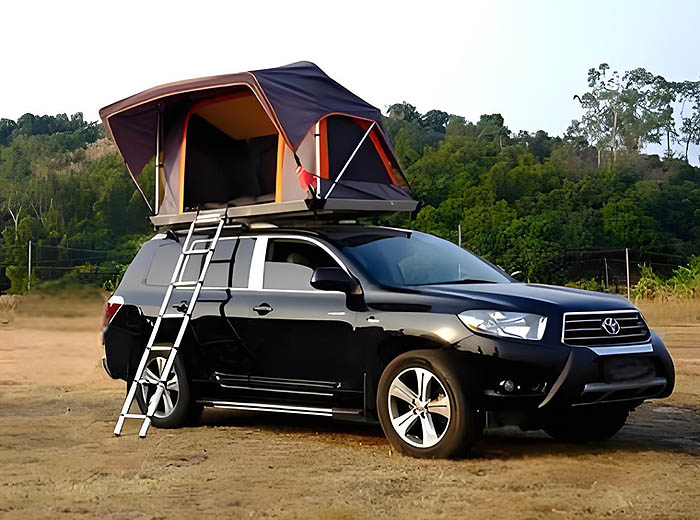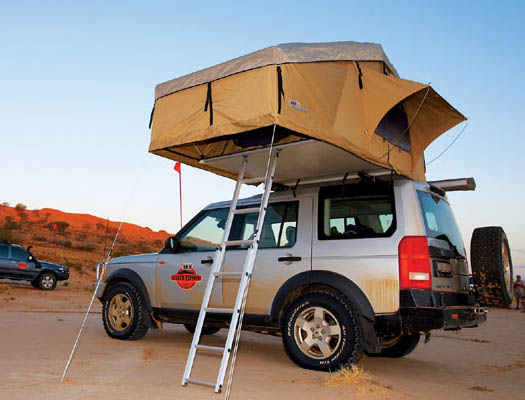

For those who are considering purchasing a roof top tent for camping or long road trips, I would like to share my real experience so that you can make an informed decision. Prices range from a few hundred dollars to thousands of dollars, but my advice is: don’t go for the cheapest option. Travel safety is more important than saving a few dollars—after all, you don’t want to run into trouble when driving at 100 km/h in the middle of nowhere.
HC-CL180 Soft Shell Roof Top Tent
I chose the HC-CL180 Soft Shell Roof Top Tent, which is made of high-quality 280g cotton canvas and Oxford polyester fabric, with excellent waterproof and weatherproof performance. It’s very easy to set up — just open the door latch, push back the canopy, unzip the entrance, and pull out the sturdy aluminum telescopic ladder.
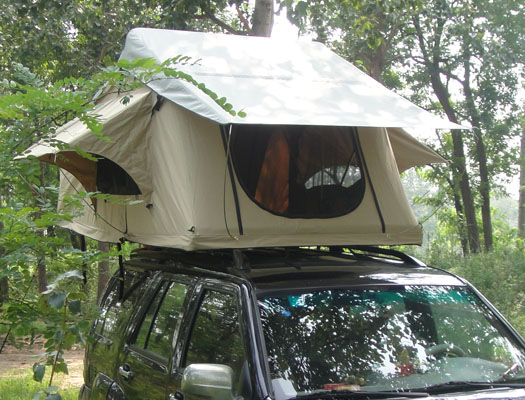
The tent interior features a high-density bonded foam mattress with a removable cover, ensuring a comfortable night’s sleep. Optional zipper attachments are available to expand storage or living space. Dual sunshade support poles maintain stability in strong winds, while insect-proof windows and doors provide ventilation and protection from pests.
Installation tips
If your car has separate longitudinal and transverse roof racks, you can install the tent directly.
If, like me, you have an integrated roof rack, you will need to add a high-quality crossbar to form a stable base.
Both the tent and crossbar can be installed DIY, but the tent is heavy—it’s still difficult for two people to lift.
Once installed, you may leave it on the car; it cannot fit in an elevator, and moving it home is impractical.
Actual Performance
1. Wind Noise
Under strong wind conditions, noise becomes noticeable when driving over 120 km/h; in calm conditions or below that speed, noise is barely audible.
2. Fuel Consumption
A fully loaded 2.0T vehicle on a long-distance trip only sees an increase of 0.2–0.3 liters per 100 kilometers—negligible in my opinion.
3. Wind Resistance
Folded: Withstood an 8-level wind test in Xinjiang—the tent remained as sturdy as ever.
Unfolded: In strong winds in Inner Mongolia, the tent swayed slightly but still felt secure.
4. Waterproof Performance
Withstood over two hours of moderate to heavy rain without any leaks.
5. Insulation Performance
In Xinjiang’s sub-zero temperatures, I stayed warm all night wearing a high-quality sleeping bag, thick blanket, and down jacket—proper gear is essential.
6. Convenience
Much more convenient than a ground tent—quick to open and close, with the sleeping bag able to be stored inside the tent, saving time and effort.
7. Durability on Rough Terrain
After 32,000 kilometers of travel, including some unpaved sections, stability was excellent as long as extreme off-road conditions were avoided.
Although a roof top tent cannot completely replace a camper van, it is one of the most practical and economical mobile living solutions for frequent road trippers. While in some cases a roof top tent may be more convenient to set up, it is not only comfortable, but also provides a higher elevation (away from ground moisture and pests) and excellent camping views.
Are you ready to turn your car into a mobile campsite? Roof top tents open up endless possibilities for off-grid adventures and spontaneous vacations. Sleep under the stars anywhere without sacrificing comfort, making every trip unforgettable.